Voyager
Visit every country on earth by making a short video call with automatic translation

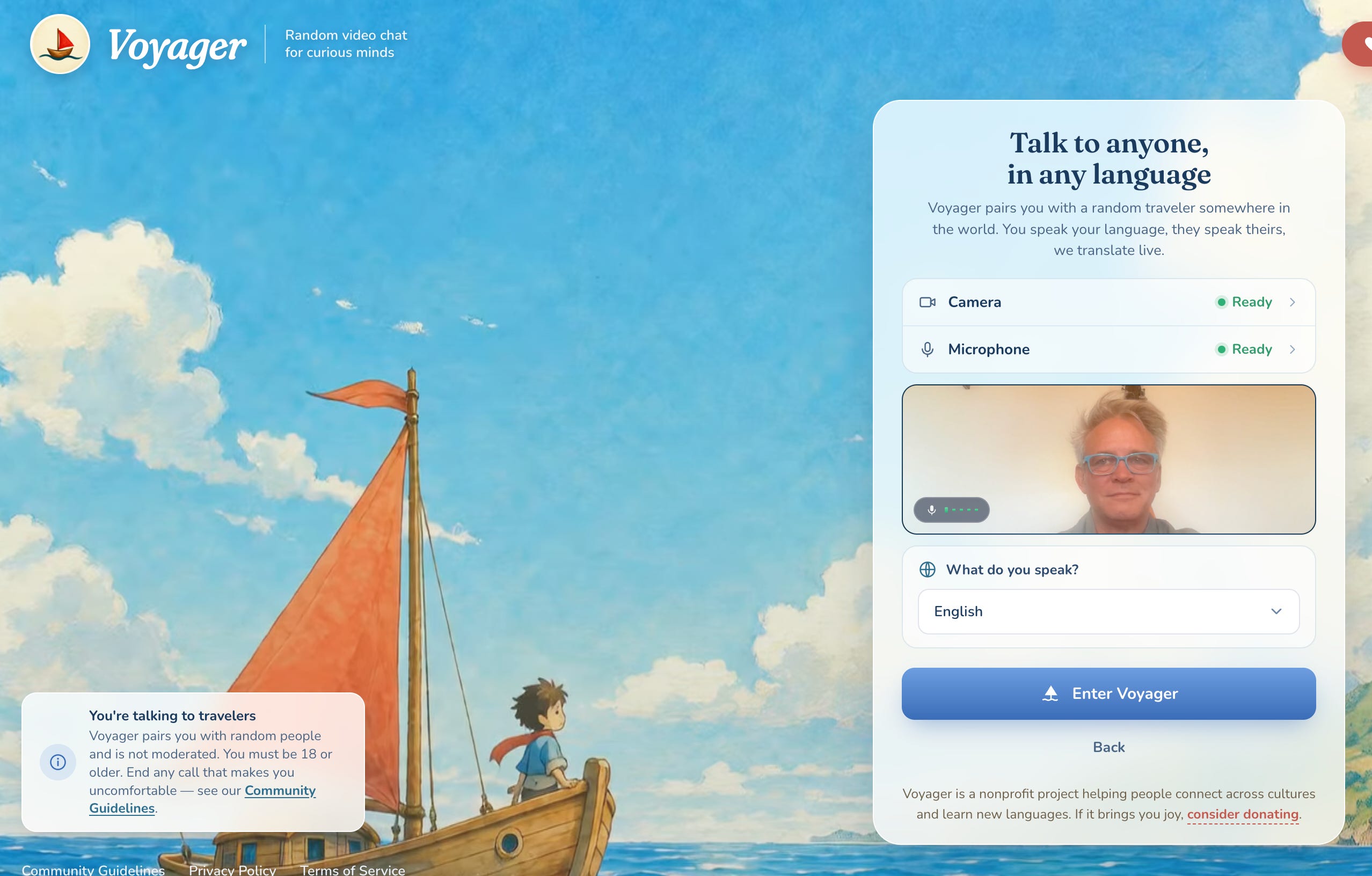
Back in the early and more hopeful days of AI, my friend Lucas Negritto and I started thinking about how to better connect the world by using translation to make it easy to talk across language barriers. The earliest translation tools (Whisper, etc) were too slow, too inaccurate, and too expensive. With the latest GPT translate, we thought we’d give it another try and we’re happy enough with the experiment to put it out there for others to try… you can test out the beta now at VoyagerCall.com.
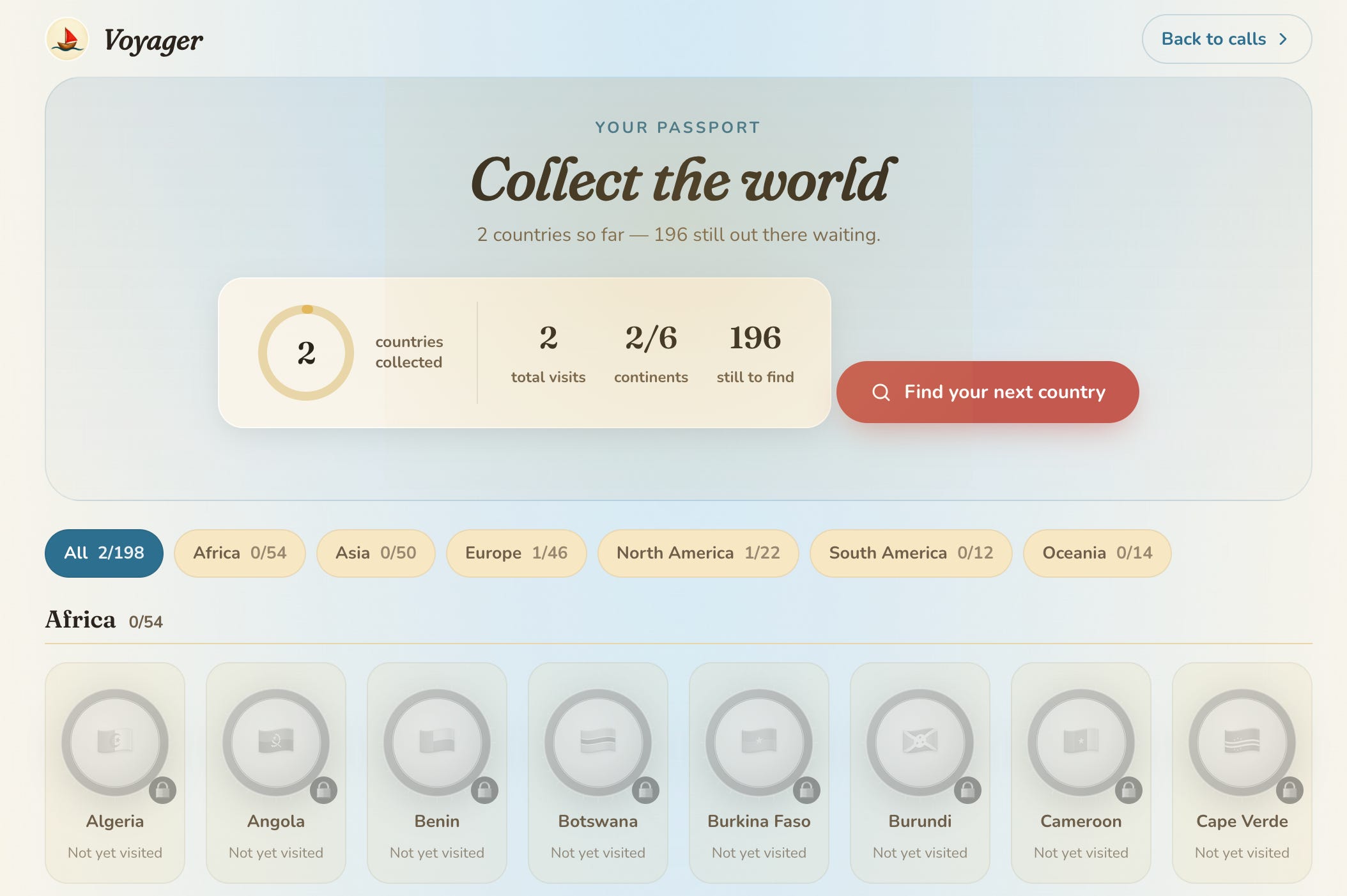
It’s a simple idea… you get randomly connected for a brief video call with a person in another country, and you both get live captions translated into your language. For each country you visit this way you get a stamp in your virtual ‘passport’. Who will be the first to visit every country? Hopefully we’ll find out soon.
Lucas and I tested the early version in 2024 in our lab with our Ukrainian friend Lidiya who laughed at seeing our english turned clumsily into her language and delighted us with her faraway words. The idea of traveling the world through short calls with an invisible translator seems magical.
Back in 1995, I build a video-conferencing app called ‘FreeVue’ which let people make video calls to strangers all over the world, and it was the beginning of my long career in tech. I will never forget connecting to a grad student in Japan and seeing the light coming into his room from a very different angle, and seeing him hold up a map with a big mark on it to show me where he was. It was an electrifying experience that stayed with me. In those days the internet was making the world much smaller, in a generally very positive way.

There are many ways to use tech to bring people closer together rather than farther apart, and hopefully this is an example - a gift. If it takes off, Lucas and I can hopefully rustle up enough donations to keep it going and pay for the translation. Enjoy!
Love this! It reminds me of Radio Garden, where you can spin the globe and listen to a radio station from anywhere else in the world 🌎🌍🌏we used it everyday during the pandemic, there’s something magical about connecting through different languages and sounds 🎧🎵 https://radio.garden/
Absolutely LOVE this idea and totally on-board. Just discovered Afrikaans on the list as well! Thank you. Afrikaans is a West Germanic language that originated in the 17th century as a dialect of Dutch spoken by the Dutch settlers in the Cape Colony. It has evolved into a distinct language with its own grammar and vocabulary, influenced by various languages including Dutch, Malay, and Khoisan languages.
Global Distribution: Afrikaans is spoken by approximately 6 million people worldwide, with a significant number in South Africa, where it ranks as the third most spoken language after Zulu and Xhosa. It is also recognized as a national language in Namibia. Due to emigration, Afrikaans-speaking communities have formed in countries such as Australia, the United Kingdom, New Zealand, Canada, and the United States. Although numbers are smaller, these communities maintain the language through cultural organizations and education. linkedin.com/in/dorette